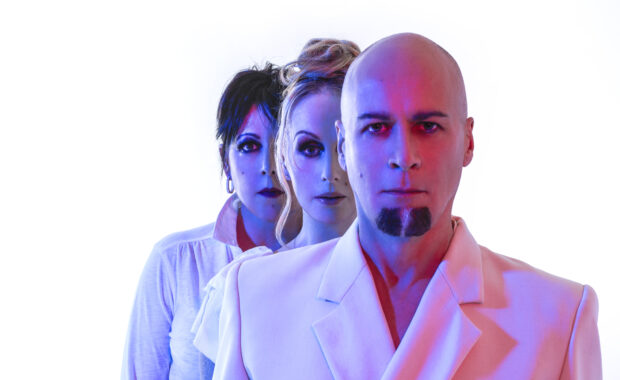
Paul Spencer Denman spent four decades shaping the pulse of sophisticated pop as the bassist behind one of music history’s coolest singers, Sade. His bass lines anchored hits like the silky noir “Smooth Operator” and everything that followed. Their sleek late-night soul met first-wave MTV, cruising through some of the most stylish videos of the era., but now he’s driving into something that rides more like a motorcycle than a limousine. Denman has teamed up with guitarist-vocalist Daniel Ash and drummer Bruce Smith, artists whose résumés include post-punk royalty like Bauhaus, Love and Rockets, PIL, and The Pop Group. Ashes And Diamonds is a trio built on post-punk pedigree and low-frequency swagger. The music hits harder and dirtier, a cinematic combination of experience and hunger, where Denman’s subtle melodic command becomes both engine and atmosphere. The band’s debut album, Ashes And Diamonds Are Forever, arrives with the confidence of musicians who have nothing to prove yet plenty left to say. We caught up with Denman to talk about everything from bass lines to Live Aid to the new record’s edge, and yes, a bit about those iconic Sade videos.

MVTM: The songs on Ashes And Diamonds Are Forever feel very bass led, which I find interesting.
Paul Spencer Denman: I tend to do that. But very simply and very subtly, for that to take effect, you need an excellent drummer. And Bruce [Smith] is a superb drummer and totally underrated, fantastic computer guy. He programs everything and he’s an ideas machine, as is Daniel [Ash]. We’re all kind of idea machines, having all these ideas all the time. Some of ’em are really crap, but they are there. We were very fortunate though, because we recorded the album twice.
MVTM: Why? What happened?
Paul Spencer Denman: We had a little bit of legalese with one of the people that worked on it with us. And so we made this decision to just rerecord everything. Literally.
MVTM: But I don’t know a musician alive that doesn’t listen to their record and pick it apart and long to correct what they think are mistakes. For this, you could change anything you wanted to in the re-record.
Paul Spencer Denman: Yeah, I could do everything better. We were really lucky. Our management got us into Johnny Depp’s studio ,and we did 12 songs in 10 days. We went over the old songs, wrote the new ones, and did it real quick, real fast. There’s a lot of energy because we had time restrictions, which I haven’t had for 40 years. But the time restrictions were helpful – we’ve gotta get this done! We’re not leaving till we get this done! We worked with Robert Stevenson, a fantastic English engineer, and he really contributed a lot. It was great.
MVTM: I wanted to ask you about other styles you’ve embraced. You and your current bandmates embraced punk and goth during your career. Were you three consciously trying to make something distinctly new – something that didn’t sound like anything you had done before? Or did you really wanna bring your legacies together and combine all of it?
Paul Spencer Denman: No, I wanted to do something different. Bruce was always doing something different, so we just wanted to do something really different. We didn’t want it to be like anyone else. We didn’t want any stars or stuff like that. But obviously Daniel gets way more attention than we do. But that’s cool, he deserves it. Yeah. And there was none of that. I didn’t want to do anything to sound like Sade.

MVTM: What’s your favorite song on the album?
Paul Spencer Denman: Do you know what? I don’t! Somebody asked me this the other day. I like them all. I really honestly do. We were so engaged, the three of us, through all of the process, especially when we honed it down at Johnny Depp’s place.
MVTM: Does this project speak to where you started and what excited you early in your career?
Paul Spencer Denman: I wouldn’t be here now talking to you if it wasn’t for the Sex Pistols. They gave me the real push to leave [the London city of ] Hull in 1977. I actually didn’t get to London until ‘79. And of course, the Pistols were all done by ‘77. I went to see the Clash in 1977 and I literally decided that day that the life that I knew was over. I was working in a factory, and I didn’t actually mind the job to be honest, but I’d been working there since I was 15. It was like, I’ve gotta get on this. This is it. This is my chance. I’ve been playing bass and been in bands since I was 13, each band doing different weird things. I obviously have a lot of playing experience. So, I was in a band, we played around, couldn’t do anything, and that all collapsed. And then I joined this band called Pride, and there was a singer in the background. There were two backgrounds, two ladies. Barbara Robinson and Sade [Adu].
MVTM: Now I find it interesting that you, when we were talking about the bass leading things, that was your role in Sade. You tend to do that well – I mean, the first bass line of “Smooth Operator” gets everyone up when played live, I imagine. And I imagine 40 years ago when you played that at Live Aid – did they blow up like that?
Paul Spencer Denman: No! I was trying to explain this not long ago. Everybody that was on that bill, all the old boys, you know – Sting, Phil Collins, you can name them all. Loads of massive hits. Everybody from our generation span on out. Duran Duran, Howard Jones – Howard was bigger than us! Nick Kershaw was bigger than us! We’d had one hit – not even “Smooth Operator” it was “Your Love Is King” – and we’re just out there. Yeah. And we did our best.
MVTM: Does it seem like 40 years ago?
Paul Spencer Denman: Yeah, definitely. It’s just, the thing is what, when you’re doing it, like at the time, it doesn’t seem like such a big deal. We made the album [Diamond Life], then on a little tour, then we’re making the second album, we break from the second album to do Live Aid, and we go back to the studio after Live Aid, and you’re just on this rabbit wheel of just that, then the album comes out, you do TV, blah, blah, blah. At the time, you don’t realize the importance of it. We really don’t. And it’s only with hindsight that you do. When I look back at it now, we were very young and very inexperienced, but I did okay.
MVTM: Sade was just a club kid at the time, right?
Paul Spencer Denman: Yes, we all were. We all fell into this club scene thing and there were some bands coming out, a lot of bands, Animal Nightlife came out, Spandau Ballet came out, Wham came out – George [Michael], we’d see each other all the time at the same clubs. And so yes, she was around and our manager, Lee Barrett, asked her to sing with Pride and they didn’t take her. So he asked him again, and they did take her. We had a lead singer, Nick Moxham. It was actually called Arriva for a bit like the first there. Tried and tried, couldn’t get anything going. The manager Lee decided to thin it all out and start again. So that’s what they were doing when they were hiring me and the drummer and Stuart [Matthewman]. They renamed it Pride. It was chaotic though, man, everything was crazy. Everything would go wrong, and then everything would go right. And we ended up playing these heavy metal nights – can you imagine that? People throwing cans at us and stuff like that.
MVTM: Let me ask you something that I remember reading in Rolling Stone. You had a gig where Sade was broken hearted, and onstage at one point, she says, “Hang on to your love. I lost mine,” and dropped the microphone and left the stage in tears.
Paul Spencer Denman: Oh yes. Frankfurt ‘86. That happened. Yeah. We were like, what just happened? Oh, she walked off? We’re still playing! Nobody knows what to do. What the fuck are we gonna do? So our drummer at the time, the late Dave Early, Dave goes, “Let’s do ‘Snakebite,” which is an instrumental we do every show. So we do “Snakebite,” ba dum ba DUM, and then we all run offstage.
MVTM: Did you find her? Had she left? Was she a mess? What happened?
Paul Spencer Denman: I knew where she’d be, so I went and found her. And we just had a big cuddle, really. I said, “It’s shit, isn’t it? Life is shit. Look what we got and look what we don’t got.”
MVTM: What do you remember about shooting the “Smooth Operator” video with director Julian Temple? Julian has those big punk roots too [Temple shot film of the Sex Pistols].
Paul Spencer Denman: Yeah, of course. We met on similar grounds and he was just really fun to work with. Very clever. We’ve been friends ever since. That instrumental “Snakebite” that I mentioned, and he did the video for that as well. And it was great fun. That was completely bonkers. Wow. But yeah. Nice guy.
MVTM: It’s in a ballroom. It’s very lush looking. Yeah. The whole thing is very, it’s got a real air of class about it.
Paul Spencer Denman: We’re the backing band in this thing, and the gangster comes in, and he goes off with the girl and all that sort of stuff, yeah. It was fun. In those days don’t forget, it is the birth of the [modern] video basically. People spend a lot of money, and could do anything.
MVTM: The band made a video for “When Am I Going to Make a Living” too.
Paul Spencer Denman: Man, that was cool. Our friend [model/actor] Christos [Tolera] is in that. He just had the coolest suit. I’m still friends with Christos. I speak to him nearly every weekend, for football, in that he’s an Arsenal supporter. Oh, I’m a Manchester City supporter, of course. But yeah, it was fun. It was a pie and mash shop, and were all in there messing about. Pie and mash, it’s a very English thing. I don’t think you’d get it anywhere else in the world.
MVTM: Not to minimize it, but it doesn’t hurt your music videos that Sade is beautiful.
Paul Spencer Denman: (laughs) I know.
MVTM: She really comes off as confident and classy, and she seems like she commands a room. Now, is that something that you could see from the beginning? Or is that something she puts on for performance?
Paul Spencer Denman: No, she was always cool. When I first met her, I thought she was really cool. I just wanted to know her. After I came, I auditioned for Pride and I didn’t know if they were gonna take me or not, or whatever. And I came away thinking, yeah, they’ve got some good songs and that kid is really cool. I wanted to get to know her a bit better. There were a lot of people around London at that time who were very cool, movers and shakers you’d call them, I suppose now. But we went to the clubs and they were cool. Everyone dressed up, and whether a club was any good, there’d be 50 people inside and 150 people trying to get in. If the club was any good, that would tell you. So we spent a lot of time in clubs messing around, getting to know each other and stuff like that. But she was always very cool. Never not cool. I think she found it when she started to get famous. She didn’t like it. And now, to be honest with you, neither did I. I used to go shopping with her down Oxford Street. It’s this big street in London and lots of clothes shops and we’re just looking, trying to look for clothes for her and stuff like that, and we ended up getting chased by people and photographers. And by 1986 it got really stupid, and they were printing all sorts of stuff about her, which was lies, and then all sorts of stuff about me and Stu, which was all lies. And none of us really liked it. She never wanted to be famous. She just wanted to write a song and have some fun with her friends. She doesn’t do a lot of interviews and stuff like that. She’s like, “Just listen to the songs.”
MVTM: Getting back to the Diamond Life album. There isn’t a bad song on that whole album. When you were finishing it, was there something about it before everybody heard it that made you think, wow, I think we’ve really got something here?
Paul Spencer Denman: Yeah. I remember when we did the final listen and everybody was just silent, just completely silent and our producer Robin Miller just turned around and he went, “Wow.” And I left and called our manager. And he says, “How is it?” And I go, “I think it’s gonna be massive.” But before that, we didn’t have any expectations. And then the label only released it in England and Europe! They wouldn’t release it in America because they didn’t think there was a market for us. And then, the record company got a bit pissed off because they were selling so many albums on import of Diamond Life and they weren’t getting any money for it. So eventually, after a lot of hooting and hollering and shouting, they released it, in 1985. It had come out the year before in England. Oh, okay. And they released it on this really fucking dipshit fucking label called Portrait, which I don’t think had any other acts. I don’t know. I know it was small, I remember. And I don’t think they expected it to do anything anyway. Well, 10 million albums later, I think they were all pleased.
MVTM: What is your favorite Diamond Life song?
Paul Spencer Denman: “Your Love Is King,” because we’re in a rehearsal space, and the drummer and I, we’re messing around, stuff like that. And Stuart and Sade are trying to write songs and they can’t write any. They haven’t really put anything together that’s really great, or that’s really grabbing anybody else and then, the door came bursting open – I know, it sounds dramatic, but it’s what happened –Steve was going, we got a song! I was like, fuck yeah, man. Show me, and he goes just to chord A to D and I was like, okay, I’ll just, what do you want me to do? And he goes, just follow. I was like, okay. Okay. So we started playing it. Drum starts playing the beat, she starts singing, and it was just like, oh fuck yeah. We got a song.
MVTM: Were you surprised that “Smooth Operator” ended up being a big hit?
Paul Spencer Denman: A little, yes. It was originally the B side of “Your Love Is King,” and it was written by Ray St. John, who I told you previously was a songwriter in Arriva and Pride. He wrote all the songs, and he wrote that particular song for Sade. So when we’re playing the Pride set, Sade would come to the front and sing one song, and it was “Smooth Operator,” and I don’t think she ever really enjoyed it.
MVTM: Now, when you came back for Soldier of Love, we hadn’t seen you guys in a while. What was different about that album for you?
Paul Spencer Denman: I think if you listen to Diamond Life and then listen to Soldier Love, they’re two completely different things, but if you start to listen to the stuff in between, you’ll see the progression. We all progressed and we all started to hone our skills. You have to do exactly the best that you possibly can do at that time, and that’s all you can do. So we put a lot of pressure on ourselves and we’d spend ages recording and, yeah.
MVTM: Any plans for a new Sade album?
Paul Spencer Denman: I’m writing now. Hopefully something next year, and then a big tour after that. On the last tour [Sade Live tour in 2011], I really thought we’d really made a statement and we’d really done something worthwhile, and that’s the first time I’ve ever felt like that.
MVTM: Getting back to Ashes and Diamonds, in the band name, is Diamonds a reference to Diamond Life or is it something else?
Paul Spencer Denman: Yes. We went to this studio to do a bit of mixing in L.A. There was a bit of downtime, so I said to Danny and Bruce, look, how about we pick a name? We didn’t have a name then. I was collecting band names for a long time. I’m wanting to call it “Ash and the Trash,” but Danny said that’s too much on him. I start reeling off these names, 50 or so, and I got to “Ashes and Diamonds” and they both went, “That’s it!” Actually, it was gonna be “Ashes, Diamonds and Pills,” because Bruce was in PiL [abbreviation for the band Public Image Ltd.], but I thought it was a bit too long, and it’s really clever, it is super, super clever. So I just knocked “pills” off. Bruce had to go (laughs).
MVTM: Will Ashes and Diamonds go on tour?
Paul Spencer Denman: No plans as yet, but you never know. What I’d like to do, though, is play some festivals. That would be cool. Oh, yeah, and do some support slots. My dream gig is Lady Gaga. I want us to support Lady Gaga.
MVTM: Do you have any bass advice for bass players in general?
Paul Spencer Denman: Keep your notes long and keep your nails short (laughs).